His Eminence Rinchen Dorjee Rinpoche’s Puja Teachings – March 22~29, 2026
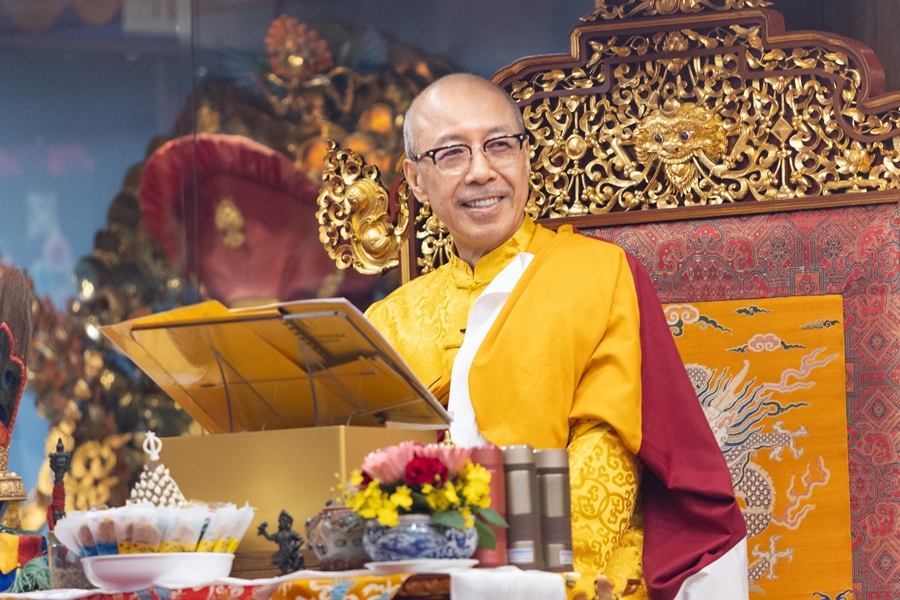
From March 22, 2026, to March 29, His Eminence Rinchen Dorjee Rinpoche undertook a seven-day retreat in the Glorious Jewel Buddhist Monastery of Rinchen Dorjee Rinpoche. This marked Rinpoche’s 34th retreat. At the same time, he led and guided 30 disciples in undertaking retreats of two to seven days for the first time at the Glorious Jewel Buddhist Monastery of Rinchen Dorjee Rinpoche.
The Drikung Kagyu lineage emphasizes actual practice, placing particular importance on retreat; all the gurus who have attained realization of siddhis throughout the generations have engaged in long-term retreat practice. Inheriting the spiritual legacy of the lineage gurus, Rinpoche has perfectly completed 34 retreats between 1997 and 2026. For the purpose of propagating the authentic Dharma and to benefit countless sentient beings, Rinpoche made great compassionate (karuṇā) vows to establish the Glorious Jewel Buddhist Monastery of Rinchen Dorjee Rinpoche, a Monastery dedicated primarily to practice and retreat. By setting the Retreat Center in the Monastery, Rinpoche bestowed disciples with an incomparably wondrous fate of entering a retreat.
In mid-spring 2026, after a year of dedicated preparation, Rinpoche led the disciples in retreat for the first time. At the very beginning of the retreat, Rinpoche performed demon dispelling, purified the disciples’ hindrances, and also gave meticulous instructions on the many details of retreat practice. During the retreat, Rinpoche personally bestowed calligraphy of earnest instructions, every word filled with his profound care and comprehensive protection for the disciples. Upon the perfect completion of the retreat, he immediately performed a fire offering liturgy to make up for any shortcomings that may have occurred during the disciples’ retreat.
The disciples express their most sincere gratitude to His Eminence Vajra Guru Rinchen Dorjee Rinpoche for establishing this incomparably wondrous and pure Monastery in this evil time of the Five Turbidities, and for demonstrating the fearless spirit of a great practitioner devoted to actual practice. Rinpoche has once again perfectly completed his retreat and, through his great compassion (maitrī and karuṇā) power, led the disciples in retreat, granting them this rare and precious fate. Throughout the disciples’ retreat, Rinpoche also compassionately (maitrī and karuṇā) blessed and protected the disciples in every thought, enabling them to complete their retreat successfully. Rinpoche’s realization is profound and vast, and his compassion (maitrī and karuṇā) is boundless. The disciples will forever hold this deeply in their hearts and remain endlessly grateful for the guru’s great benevolence.
At 3:30 p.m. on March 22, Rinpoche ascended the Dharma throne in Bodhisattva Avalokiteshvara Monastery and compassionately (maitrī and karuṇā) performed demon dispelling to purify the disciples’ hindrances. He also performed the liturgy of Dharma Protector Achi and the furious Achi, and bestowed precious Dharma teachings:
This retreat is a retreat of the Dharma method of Avalokiteshvara. What I just performed was the demons dispelling, because your karmic hindrances are relatively heavy, so many Dharmas must be performed beforehand. It was not like when I entered the retreat, His Holiness did not perform any Dharma for me. He simply told me to go into retreat, and I did, because he had great confidence in me, but I have no such confidence in you. You are not truly practitioners, but there is no other choice; this is my vow power, retreat is the way of practice in the Drikung Kagyu lineage. Some people asked whether they could take a shower; do not be so proud, you are not the same as me, the retreat I undertook was a life-or-death retreat. In such a retreat, one cannot take a shower and cannot leave until one has achieved attainment with the yidam. At most, what you are doing can only be considered a retreat to form a fate. Do not think you are truly in retreat, this is only to let you briefly experience what a proper and disciplined life is like, without anyone disturbing you, so that you may reflect on how many mistakes you have made. The mind must become completely still, like the surface of water. This is extremely difficult. Whatever you are doing, your mind should always remain on the Great Six-Syllable Mantra.
The number of recitations during these few days is not important. Simply recite as much as you normally do; there is no need to deliberately increase the number. If one can recite 100,000 times, one will not fall into the Three Evil Realms; if one recites one million times, one may be reborn in the Pure Land—this is stated in the sutras. However, these recitations only count when they are done during retreat; those done in daily life do not count. Do not think that after completing this retreat, you will become different or turn into another person—you won’t. With such a short retreat, you will not see anything in particular, nor will you experience any responses.
If you feel physically unwell, you may press the emergency button, and someone will come to assist you. Do not die in the retreat room, pressing the button will not cause any problem; it will simply mean that your retreat has to stop. Do not be so selfish; if something serious were to happen and an ambulance had to be called, the disturbance would cause others to continue their retreat and would also cause many problems for the Monastery. Do not expect that just a few days of retreat will improve your health. If you are constantly thinking about your body getting better, that will not happen. Especially you, Disciple Fei, if you feel unwell, you must speak up (Disciple Fei nodded repeatedly). And Disciple Zhu, do not think that retreat will make your health better; it will not. Relax, you will not die in there. Rinpoche then gave further teaching to a male monastic, reminding him not to assume that simply entering retreat could lead to enlightenment; this is absolutely impossible.
You may repent, but it’s ok to be just about right? That is—you do not need to cry so loudly that it disturbs everyone around you. If your crying disrupts others so they cannot continue their retreat, it only shows that you normally do not repent, crying a little is enough. This is not meant to be a place for you to vent your emotions, even though it may have some great psychological benefits.
Many among you are gossipers, if anyone complains about the retreat rooms and it reaches me, then do not come again. Some of you spend all your time criticizing others. Why don’t you first examine yourselves? Some of you women are really troublesome, even asking whether you can take a shower.
Each day, you should complete five to seven sessions of practice. You may rest between sessions, and how long to rest is up to you. You may also rest at noon and close your eyes for a while, but do not sleep like a pig.
You should refrain from eating too much during each meal—just eat until you are 70-80% full, otherwise, when you stuff yourselves, your body will need to consume energy to digest food, and that will impact your mantra-recitation; sometimes I even skip a meal. Do not fear wasting food, you already waste a lot of food on a regular basis. During the retreat, one must abstain from speaking, do not talk, not even muttering to oneself; you have all become accustomed to speaking as you like. The moment you begin speaking to yourselves, you must repent immediately, otherwise the retreat of speech would be gone. If you want to talk, you can replace your words with the Great Six-Syllable Mantra.
If there’s anything, you may write a note, for instance, you can write a note when you don’t have enough water. But if there isn’t enough water, you can just drink tap water—it won’t kill you, perhaps give you diarrhea at most. There are only six administrative staff working in the entire Monastery, and ministering to your three meals is already enough work for them.
When reciting the mantra, our bodies feel temperature differently, so you must keep yourselves warm; it’s better to be a bit warm and sweat than to take off your clothes. If you feel cold, it means you’re already getting a cold. You can turn on the heat as much as you need. You are different from me since I have cultivated and attained Kundalini (inner fire), and I still feel hot when wearing only my underpants. You must not spit; you most likely won’t do this. It is okay to spit when brushing your teeth, as I don’t believe you can swallow that. If you cough, you must count backwards ten prayer beads, fifteen if you sneeze, and ten if you yawn. During retreat, all dreams are auspicious, even nightmares; do not be attached to what dreams you might have. You must not have empty bottles in the room, which means that the retreat will not be perfectly completed. Do not flip your seat cushion around, and you must not get up to do things within one session, such as going to the restroom. You must arrange all matters, major or minor, ahead of time. If you get up, you must start all over with that session.
Before beginning your first session each day, first recite Vajrasattva; the number of recitations is up to you. A session means a fixed number of recitations or practices, and you may decide the number yourself. Since you do not have purified water, Rinpoche then instructed the disciples on the visualization for blessing the prayer beads, and gave the following teachings: There is a text to be recited after completing one session, if it can be found, it will be given to you. If not, after completing a session, you may recite: ‘I make offerings to the yidam, the guru, and the Dharma protectors. I dedicate this to Anuttara-samyak-saṃbodhi. May all sentient beings have the causes and conditions to practice.’Do not dedicate the merit to any specific individual. Tonight, you may first complete one session, and then practice Achi.
Are there any other questions? Do not imitate me in not bathing and washing my hair, and you may use your cosmetics, otherwise when you emerge, your husbands will not recognize you. Next, Rinpoche asked the mosaics whether they had any questions. (The monastics reply: Reporting to Rinpoche, no questions.) On February 29th, at 9:30 AM, I will perform a Fire Offering on your behalf.
Next, the disciples reverently sent Rinpoche off as he descended the Dharma throne, and immediately entered the retreat rooms afterwards.
At noon on March 26th, when the disciples received their lunch, they suddenly saw a handwritten message that Rinpoche composed personally, ‘You all have two days remaining before concluding your retreat. During these two days, you may slow down slightly and allow for longer periods of rest. The rooms are hot in the afternoon, so be sure to turn on the air conditioning to avoid heatstroke. I bless you every day. May you make progress in both your lives and in the Buddha Dharma during this retreat. May everything be perfectly auspicious. —Written by Rinpoche.’Between the lines of these words, one could clearly feel the guru’s extraordinarily meticulous and profound compassion (maitrī and karuṇā), as well as his complete care and boundless protection over the disciples’ practice and physical and mental well-being. After respectfully reading the message, the disciples were unable to hold back their tears, deeply moved by the guru’s compassionate (maitrī and karuṇā) and attentive care. Their gratitude was beyond words.
On March 28th, right before Rinpoche’s retreat was about to come to perfect completion, dozens of eagles suddenly, quietly began to circumambulate the air above Rinpoche’s retreat house, and gradually they flew across to the area above the Monastery. A fine rain descended from the sky, and yet it did not wet the body, like nectar covering and nourishing every being. Rinpoche’s compassionate (maitrī and karuṇā) vows are vast and profound, and are praised by the various heavens.
In the morning of March 29th, Rinpoche emerged from retreat upon attaining perfect completion, and the disciples emerged from retreat at 8:00 AM under Rinpoche’s instructions. At this moment, fine rain fell from the skies, bringing refreshing coolness, like the guru’s compassion (maitrī and karuṇā), showering graces upon the sentient beings.
At 9:30 AM, Rinpoche ascended the Dharma throne to perform the Fire Offering. Before performing the Dharma, Rinpoche bestowed teachings before the Fire Offering Mandala: One practices the Fire Offering to compensate for the imperfections during your retreat, such as falling asleep, yawning, etc. Since most of you are over 60, you would not be able to run even if I asked you to. Thus, Rinpoche instructed one male and one female monastic disciple to represent all sentient beings in depositing the offerings into the Fire Offering Mandala. Next, Rinpoche donned the dignifying and solemn Fire Offering Dharma crown, Dharma robes, and began to perform the Dharma.
Rinpoche personally placed the auspicious (kusa) grass and instructed the staff members to light the fire, the blazing flame formed all sorts of incomparably wondrous fire shapes, the form was ever-changing, as if the Fire Deity and the yidam had emerged, it was extremely, incomparably wondrous. At this moment, the ground shook, dozens of eagles circumambulated the air above the Mahavira Hall and the Fire Offering Mandala, as if the Dakinis had come to watch over and grant protection. The two monastic disciples took turns in representing sentient beings to receive the offering items and depositing them into the Fire Offering Mandala as an offering to the yidam. Rinpoche also instructed the disciples to recite the Great Six-Syllable Mantra simultaneously. Suddenly, the once cloud-covered sky of gentle rainfall brightened, and rays of spring sunshine emerged, a gentle breeze blew, and butterflies danced about, the lotus blossoms in the pond before the Mahavira Hall bloomed, the frogs croaked in unison, and the golden carp leaped from the water again and again. All sentient beings of the Dharma Realm are graced by Rinpoche’s merits and Dharma benefits. Next was the Tsok Liturgy (Puja Teachings Index 03), and the guru bestowed disciples with the incomparably wondrous fate to share food offerings with the guru, the Buddhas, and the Bodhisattvas. The hearts of the disciples were filled with utter Dharma joy and gratitude.
Rinpoche continuously performed the Dharma for over three hours within the state of changding(Puja Teachings Index 06), the Fire Offering had come to incomparably wondrous perfection. At 1:00 PM, Rinpoche then bestowed teachings in the Mahavira Hall on the incomparably wondrous merits of Fire Offering:
Today, I perform the fire offering for everyone who had completed the retreat. In Tibetan Buddhism, one must be a Rinpoche to perform the fire offering; ordinary Khenpo can only perform the smoke offering. Fire offering isn’t something that can be accomplished merely by reciting the Dharma text; one must cultivate to reach attainment with the yidam. I remember when I had just come into contact with the Drikung Kagyu lineage, His Holiness had performed the fire offering once. The other time was after the 2007 retreat; he performed the fire offering for three or seven days. Therefore, the fire offering is very important.
Before the Monastery was constructed, I performed four fire offerings. After the construction of the Monastery was completed, I performed another four fire offerings. Fire offerings are divided into: Santikarma(Puja Teachings Index 25), for pacifying disasters; vasikarana(Puja Teachings Index 26), for conciliation; paustikakarma(Puja Teachings Index 27), which means to increase; raudrakarmana(Puja Teachings Index 28), which means killing. Why is the performance of fire offering liturgy necessary? Because this area is surrounded by desolate mountains and wilderness, there are many sentient beings here. If the four fire offering liturgies weren’t performed before construction, there must be many incidents that happen during the construction process. Fortunately, throughout the eight years of construction, there were no major construction accidents. After the Monastery was constructed, another four fire offering liturgies were performed with the hope that this land and this Buddhist Monastery would unceasingly benefit sentient beings. Because the fire offering liturgies were performed, anyone who comes to visit the Monastery, the good fortune is different than others. Especially in Taiwan, it is very unlikely for one to perform eight fire offering liturgies in such a short period of time. Performing a fire offering is very exhausting, as you all just knew, it took three hours.
The fire offering of santikarma(Puja Teachings Index 25) can pacify illness and obstacles. The fire offering of paustikakarma(Puja Teachings Index 27) can increase good fortune and wisdom, lifespan, wealth, and complete happiness. In the aspect of vasikarana(Puja Teachings Index 26), it can heal illness and pain, and also increase wealth, status, and authority, etc. In the aspect of raudrakarmana(Puja Teachings Index 28), it can overcome the hindrance of evil behaviors and evil karma.
The supramundane benefits of the fire offering are: the fire offering liturgy of santikarma(Puja Teachings Index 25) can eliminate two types of hindrances— the hindrances of knowledge and affliction; this is the attainment of the sambhogakaya (Puja Teachings Index 08) fruition of Vajrasattva of the East and all yidams of santikarma(Puja Teachings Index 25). In the aspect of paustikakarma(Puja Teachings Index 27), enabling one to obtain the attainment of the sambhogakaya (Puja Teachings Index 08) fruition of the Buddhas of the South and all paustikakarma(Puja Teachings Index 27) yidams. In the aspect of vasikarana(Puja Teachings Index 26), it can call forth good fortune and wisdom, eliminate the two hindrances of knowledge and affliction, enabling one to obtain the attainment of the sambhogakaya (Puja Teachings Index 08) fruition of Amitabha of the West and all vasikarana(Puja Teachings Index 26) yidams. In the aspect of raudrakarmana(Puja Teachings Index 28), it breaks away the attachment to self, eliminates the four demons; using the sūnyatā (Puja Teachings Index 21) wisdom of furious yidams to break, shatter, and kill the two hindrances and the four demons, enabling one to obtain the attainment of the sambhogakaya (Puja Teachings Index 08) fruition of Amoghasiddhi of the North and all raudrakarmana(Puja Teachings Index 28) yidams.
The fire offering liturgy is an extremely incomparably wondrous Dharma method of Vajrayana; by burning offerings as a method to make offerings to the yidams, and above to make offerings to all Buddhas, and below to the Six Realms; it can swiftly eliminate the hindrance of karma, perfect the good fortune, wisdom, and resources; enabling one to obtain attainment in both mudane and supramundane world. Cultivation of Buddha Dharma is through various liturgies outside, to enlighten the Buddha nature fully possessed in each individual, thereby allowing one to leave suffering and obtain happiness. The fire offerings liturgy is when the practitioner practices the fire offerings liturgy, visualizing the palace or mandala where the Buddhas or Dharma protectors reside. Outwardly, it appears as the image of fire; inwardly, it is the Buddhas, Dharma protectors, and the members. Visualizing the offerings as offerings that are limitless and boundless, above to the guru, and through merit power of the cultivation of the practitioner, the blessing power of the Buddhas and Bodhisattvas, the power of sincerity of the participants, swiftly eliminates the hindrance of karma, perfects the Six Paramitas, and benefits others by benefiting oneself.
There are four main categories of recipients of offerings: First, it is making offerings to the Buddhas, Bodhisattvas, and the yidam. Second, it is making offerings to Dharma protectors and deities with higher abilities. Third, it is making offerings to all sentient beings. Fourth, it is making offerings to the ghosts and the Hungry Ghost Realm, at the same time, especially making offerings to those karmic creditors whom we have owed evil karma.
What are the merits of fire offering? The fire offerings of santikarma(Puja Teachings Index 25) can pacify one’s illness, pain, and hindrances, and is also able to overcome all evil behaviors and karma. The fire offering of paustikakarma(Puja Teachings Index 27) can increase good fortune, wisdom, and longevity, as well as bring about wealth, fulfillment, and happiness. The fire offering of vasikarana(Puja Teachings Index 26) can counteract illness and pain, increasing authority and status. The fire offering of raudrakarmana(Puja Teachings Index 28) can overcome evil behavior, evil karma, hindrance, and etc. In summary, increasing longevity, eliminating illness, improving luck, opening wisdom, planting good fortune, getting a child, resolving doing evils, bringing prosperity to business, promoting family harmony, and contributing to peace in the nation, the merits are literally immeasurable and boundless. Fire offering liturgy can also transfer consciousness.
Qualifications for one to preside over a fire offering liturgy: First, one must have accomplished attainment in at least one yidam, or have completed a retreat of more than three years. Second, one must be in the union of both Exoteric and Vajra, possess lineage and be familiar with the liturgy. Third, one must possess great Bodhicitta. Fourth, one must possess pure precepts of the Three Vehicles, liberation precepts, Bodhisattva precepts, and Vajra precepts. Unlike ordinary Buddhist liturgies, fire offerings liturgy has a higher requirement for those who preside over the Dharma. Therefore, it cannot be practiced by ordinary people; even monastics are not permitted to practice. One must be of Rinpoche level or higher.
What should one pay attention to when participating in a fire offering? If one participates with Bodhicitta, in a wish that all sentient beings may obtain safety and happiness through the fire offering liturgy, this is the most incomparably wondrous one. If one’s motivation is for the happiness and well-being of this present life, then through relying on the blessings of the guru and the Three Jewels, one’s wishes may indeed be fulfilled. However, one should generate the intention to benefit all sentient beings, and wish that the Buddhas and bodhisattvas grant wealth, status, and so forth for that purpose. Before making any prayers, one should always include the intention of benefiting all sentient beings. Here it is stated that offerings should be received in order— do not cut in line or crowd. This is a preliminary understanding of fire offering.
Next, Rinpoche led the assembly to perform the liturgy of Dharma Protector Achi and the furious form of Achi.
After performing Achi, Rinpoche asked the disciples: Does anyone feel unwell after emerging retreat? (Disciples reply: No, we are grateful to Rinpoche!)